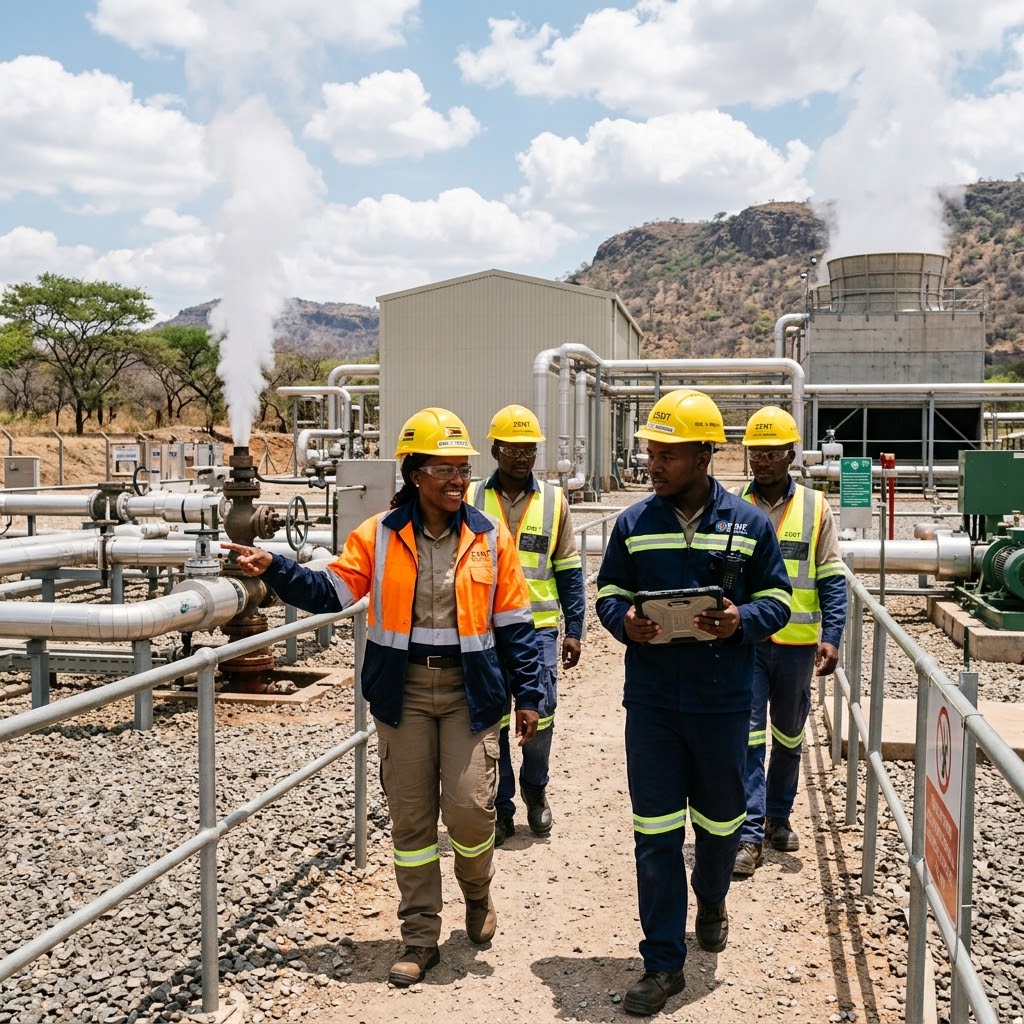
Zimbabwe could realistically add about 50 MW of round-the-clock, drought-proof geothermal power to the national grid by the mid-2030s, and 100–150 MW if drilling confirms the hotter reservoirs, starting with a 10 MW pilot at Binga.
That is small next to Kariba or Hwange, but it is firm power that does not depend on rainfall, coal supply or sunshine.
Why this conversation matters now
2026 has been Zimbabwe’s strongest power year in two decades. By the end of May the country had gone 161 consecutive days without load shedding, with local generation of 1,947 MW against a forecast evening peak of 1,760 MW (ZELA, September 2026, drawing on ZESA’s weekly Cabinet report).
But the recovery rests on two sources that have failed before. Coal from Hwange and its expansion units supplied roughly 59% of local generation, with two of Hwange’s six older units out of service; Kariba, dependent on each year’s Zambezi water allocation, supplied most of the rest, with one of its eight units out until 2027 (ZELA).
Demand is also climbing. ZETDC has received about 2,500 MW of new load applications, and a system of roughly 3,000 MW must almost double by 2030; about 4,000 MW of new projects are lined up to do it (The Herald, August 2026). Geothermal offers what that pipeline most needs and what solar cannot give on its own: steady, low-carbon baseload power, 24 hours a day, whatever the rainfall. It deserves a place alongside hydro, solar and coal.
What geothermal power generation is
Geothermal power turns the Earth’s own heat into electricity. Below the surface, rock temperature rises with depth. Where groundwater seeps down through faults and fractures, it is heated by that rock and collects in underground reservoirs. Hot springs are the visible sign that such a system exists.
A geothermal plant drills production wells into the reservoir, brings the hot water or steam to the surface, uses its heat to spin a turbine, and then pumps the cooled water back underground through reinjection wells. Reinjection keeps the reservoir pressurised and is what makes the resource renewable: the heat is replenished from the Earth’s interior, and the water is recycled.
There are three main plant types, chosen by how hot the resource is:
| Plant type | Resource temperature | How it works | Fit for Zimbabwe |
|---|---|---|---|
| Dry steam | Above ~235 °C, steam-dominated | Steam from the well drives the turbine directly | Unlikely; no known steam fields |
| Flash | Above ~180 °C, hot water under pressure | Pressure drop “flashes” water to steam, which drives the turbine | Possible at the hottest reservoirs, if confirmed by drilling |
| Binary (Organic Rankine Cycle) | ~75–180 °C | Hot water heats a second fluid with a low boiling point; its vapour drives the turbine | Best fit for most Zimbabwean sites |
Three features make geothermal stand out:
- Baseload. Plants typically run at 80–90% capacity factor, versus roughly 20–25% for solar PV.
- Weather-proof. Output does not change with rainfall, cloud or season.
- Small footprint and low emissions. Binary plants are closed-loop and emit almost nothing in operation.
Modular wellhead units of 1–15 MW can now be installed within months of drilling, generating income while a larger field is still being proven (Chinhengo et al., 2024). That lowers the entry barrier for a country starting from zero.
Zimbabwe’s geothermal setting
Zimbabwe is not a volcanic country like Kenya or Ethiopia, so it will not host giant steam fields. What it has is a network of faulted, heat-producing rock where groundwater circulates deep and returns hot. Between 20 and 30-plus thermal springs are on record, with surface temperatures between about 50 °C and 97 °C (Chinhengo et al., 2024; DLA Piper Africa, 2019). The Ministry of Energy and Power Development has previously identified 32 potential geothermal sites (ThinkGeoEnergy, 2023).
The springs cluster in two geological zones:
Magondi belt (north-west)
The Zambezi Valley and Lake Kariba shoreline, including Binga and Lubimbi in Matabeleland North and the Kariba area. This group has the largest number of springs.
Limpopo mobile belt (south-east)
The Save Valley side of Manicaland, including Rupisi near Chipinge, Hot Springs near Nyanyadzi, and Wengezi.
A 2026 GIS mapping study by University of Zimbabwe researchers ranked Matabeleland North and Manicaland as the provinces with the highest geothermal potential, matching where the hottest springs sit (Chirenje et al., 2026).
Where plants could be built
Six sites stand out in past reports, led by Chimbwatata in Binga, where government has already announced a 10 MW plant.
| Site | Province | Surface temperature | What the reports say |
|---|---|---|---|
| Chimbwatata (Chibwatata) Hot Springs, Binga | Matabeleland North | Up to ~90 °C | 10 MW binary plant announced in 2023 under a Green Climate Fund–backed programme; still listed as announced, with no construction reported as of September 2026; resampled in 2020–23 |
| Lubimbi Hot Springs, near the Gwayi River | Matabeleland North | Among the hottest in the country | Rated high potential for supplementary power (Chikwama et al., 2022); resampled 2020–23 |
| Kariba / Gache Gache road springs | Mashonaland West | ~90 °C | Hottest recorded surface water, close to Kariba’s grid infrastructure |
| Rupisi Hot Springs, near Chipinge | Manicaland | 62 °C | Accessible, on the Limpopo-belt side; resampled 2020–23 |
| Hot Springs (Nyanyadzi) | Manicaland | Hot, used as a resort | Resampled 2020–23; off the A9 Mutare–Birchenough road |
| Wengezi | Manicaland | Warm to hot | Resampled 2020–23 as part of the Limpopo-belt group |
The most important finding comes from chemistry, not surface temperature. Chinhengo, Meck and Misi (2024) used chemical geothermometers on eight springs and estimated underground reservoir temperatures of 72–268 °C, averaging 134–209 °C, with water circulating 3.8–9.7 km deep (Journal of African Earth Sciences). That places Zimbabwe’s systems in the low-to-medium temperature class, suitable for binary plants and possibly combined binary-flash plants.
Reservoirs several kilometres down mean exploration drilling is the biggest cost and the biggest risk. Slim-hole drilling at Binga and Lubimbi would be the logical first test.
How many megawatts could geothermal add?
A realistic estimate is about 50 MW by the mid-2030s, with an upside of 100–150 MW if drilling confirms the hotter reservoirs. The only published national figure is Koenig’s 1990 estimate of around 50 MWe from the Magondi and Limpopo belts (cited in Chinhengo et al., 2024). The phased estimate below is this article’s own, built from the site data above.
Chimbwatata, Binga. The announced government project.
Lubimbi, Kariba, Rupisi, Hot Springs. Modular binary wellhead units of 5–10 MW each; matches Koenig’s ~50 MWe.
Best 2–3 fields expanded, plus enhanced geothermal trials. Only if deep wells confirm reservoirs near the 134–209 °C averages.
What that means for the grid, assuming an 85% capacity factor:
- 50 MW produces about 370 GWh a year, roughly what 190 MW of solar PV would deliver, and more than all 121 MW of utility and captive solar installed in Zimbabwe by May 2026 (ZELA), but day and night.
- 50 MW equals about 2.5% of the 1,947 MW of local generation recorded in late May 2026.
- 100–150 MW would be 5–8% of that output, comparable to a small thermal station, with no fuel bill, and just under 4% of the 4,000 MW pipeline planned to 2030.
These are planning figures, not proven reserves. No exploration well results have yet been published to confirm any reservoir, so every number here should be read as a range to be tested.
The investment gap: geothermal is missing from ZERA’s pitch
The Zimbabwe Energy Regulatory Authority’s Investment Overview still does not mention geothermal at all (checked 30 September 2026).
The page markets Zambezi hydro (an estimated 5,000 MW along the river), mini-hydro in the Eastern Highlands, solar PV (over 300 MW of potential), wind, 12 billion tonnes of coal, about 40 trillion cubic feet of coal-bed methane, biofuels, and biomass (150 MW from forest residue). Geothermal, a resource with 30-plus mapped springs and a government-announced plant, is absent.
That omission matters because investors read the regulator’s list as the menu. A resource that is not on it has no signal of licensing appetite, tariff treatment or incentives. It also sits oddly beside government’s own actions: the Climate Change Management Department is promoting the Binga plant as an independent power producer project, and ZESA’s leadership has referred to geothermal alongside solar as part of its green generation plans (ZimEye, 2025).
Geothermal is a renewable energy source. Its heat is continuously replenished from the Earth’s interior, and reinjection returns the water to the reservoir. It belongs in the same investment category as solar, wind and hydro, and ZERA’s overview should say so, with the known sites, the Binga pilot and the incentives on offer (Build-Own-Operate-Transfer deals, negotiable tax holidays, and the kind of duty-free import status already given to solar equipment).
Long-term benefits alongside other sources
Geothermal will not replace Kariba or Hwange. Its value is that it fills the gaps they leave.
| Source | Main weakness | What geothermal adds |
|---|---|---|
| Hydro (Kariba) | Output depends on each year’s Zambezi water allocation; storage fell below 1% of usable water in late 2022 (ThinkGeoEnergy), and one of eight units is out until 2027 | Output independent of rainfall |
| Solar PV | Daytime only; needs batteries for evenings | Night-time and evening-peak baseload |
| Coal (Hwange) | About 59% of 2026 generation; two of six older units were out of service in May 2026; emissions | No fuel purchases, very low emissions |
| Imports | Foreign currency cost; 188 MW imported in one week of May 2026 | Local energy once built |
Other long-term gains:
- Decades of life. Well-managed fields run for 30–50 years at stable cost, because there is no fuel price to swing.
- Rural development. Binga, one of the country’s poorest districts, would gain jobs, grid reinforcement and spin-off uses of warm water after power generation: fish farming, crop drying, greenhouses and tourism.
- Skills. Drilling and reservoir expertise built at home can later serve Zambia and Mozambique, which share the same geology.
The risks to be honest about
- Exploration risk. Deep drilling is expensive, and a dry well is lost money. Early drilling usually needs grants or risk-sharing funds.
- Unproven reservoirs. Current temperature estimates come from water chemistry, not wells.
- Community and cultural rights. Binga’s springs have spiritual significance, and local chiefs have asked to be consulted before any development (The Herald, 2022).
- Scale. Individual plants will be small (5–15 MW), so costs must be kept lean through modular units.
The way forward
Zimbabwe can move from 32 mapped sites to its first geothermal megawatts in five practical steps:
- Put geothermal on ZERA’s investment list, with the known sites, available data and a clear licensing path for geothermal IPPs.
- Fund slim-hole exploration drilling at Binga and Lubimbi first, using climate finance and risk-sharing facilities such as the Green Climate Fund and regional geothermal risk-mitigation programmes, so that private investors are not asked to carry the drilling risk alone.
- Set a feed-in tariff or auction window for firm renewables that rewards 24-hour output, not just cheapest daytime energy.
- Deploy modular binary wellhead units so each successful well earns revenue within months, instead of waiting years for a central plant.
- Partner with host communities in Binga and Manicaland from day one, sharing benefits through local jobs, warm-water enterprises and respect for sacred sites.
Geothermal is not a silver bullet. But a steady 50–150 MW that never stops for drought or darkness is exactly what a hydro-dependent grid needs, and Zimbabwe already knows where to start digging.
Sources
- Zimbabwe Environmental Law Organisation (September 2026). Zimbabwe half year electricity situation, based on the ZESA Holdings Weekly Cabinet Update Report for the week ending 29 May 2026.
- The Herald, via Zimbabwe Situation (August 2026). Zim eyes 4000MW generation capacity by 2030.
- Global Energy Monitor. Chimbwatata Hot Springs geothermal power plant (status: announced).
- Chinhengo, F., Meck, M.L. & Misi, S.N. (2024). Reservoir temperatures and fluid circulation depth of selected thermal springs in Magondi and Limpopo mobile belts of Zimbabwe. Journal of African Earth Sciences, 215.
- Chirenje, K.C. et al. (2026). Mapping geothermal power potential using GIS aided multi-criteria decision analysis, a case study of Zimbabwe. Environmental Research Communications, 8(6).
- Zimbabwe Energy Regulatory Authority. Investment Overview.
- ThinkGeoEnergy (2023). Zimbabwe to build first utility-scale geothermal power plant.
- Zawya (2023). Zimbabwe to construct first utility geothermal power plant.
- DLA Piper Africa (2019). The power of the unknown: Geothermal energy in Zimbabwe.
- The Herald (2022). Binga hot springs: Zim’s unique tourist attraction.
- allAfrica / The Herald (2025). The hot springs that can’t be tamed, commercialised.
- Pindula. Rupisi Hot Springs.
- Zimbabwe Field Guide. Hot Springs, Manicaland.
- ZimEye (2025). New units coming, but will ZESA solve Zimbabwe’s power crisis?