SpaceX’s Starship Flight 14 Reaches Orbit — and Unleashes the Next Generation of Starlink
A historic Starship flight has opened a new chapter for SpaceX’s satellite-internet network, deploying 26 powerful Starlink V3 satellites designed to dramatically increase capacity.
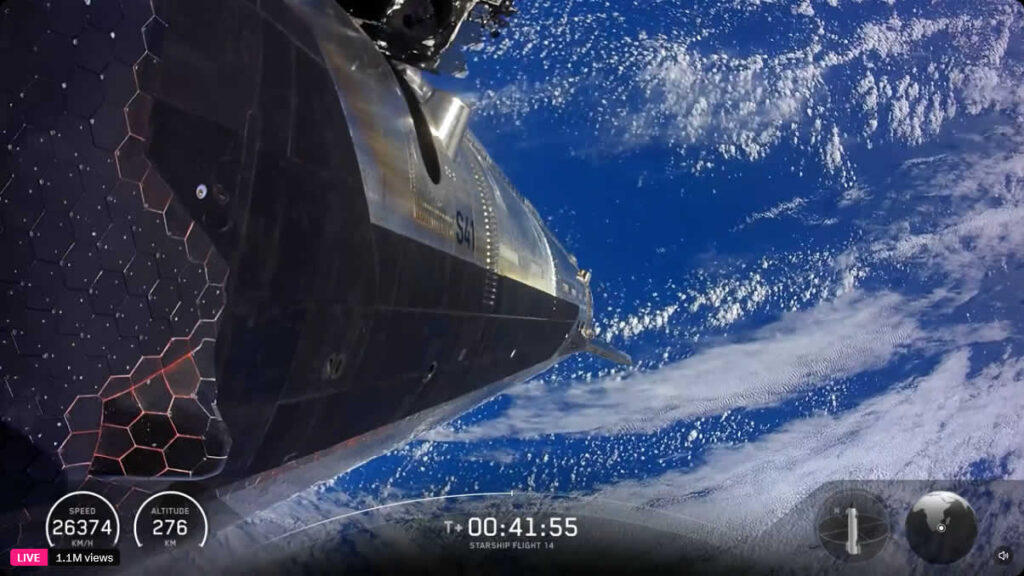
SpaceX has crossed a major milestone in its Starship programme. On 28 September 2026, Starship Flight 14 lifted off from Starbase, Texas, and became the first Starship mission to reach orbit. The mission also carried the first operational batch of 26 Starlink V3 satellites into orbit.
The achievement is significant for two reasons. It represents a major step forward for Starship itself, SpaceX’s next-generation heavy-lift launch system, while simultaneously introducing a new generation of Starlink satellites designed to dramatically increase the capacity of the company’s global broadband network.
- 26 Starlink V3 satellites deployed
- 1 Tbps designed downlink capacity per V3 satellite
- 160 Gbps designed uplink capacity per satellite
- 26 Tbps of theoretical aggregate downlink capacity across the 26-satellite payload
- 2,048 downlink and 2,048 uplink beams per V3 satellite
- ~64× increase in throughput handled per modem chip
A Historic First for Starship
Before Flight 14, every integrated Starship-Super Heavy flight had followed a suborbital trajectory. Flight 14 changed that. The vehicle reached orbit for the first time, marking a major milestone in the development of SpaceX’s enormous reusable launch system.
The mission was not completely trouble-free. Reuters reported that one of Starship’s engines shut down earlier than planned during the flight, initially creating uncertainty about whether the vehicle would be able to reach orbit. Engineers subsequently determined that Starship could continue with the critical manoeuvre needed to enter orbit.
Reaching orbit demonstrates that Starship has progressed beyond its previous suborbital test flights and can now begin performing the role for which the system was designed: carrying substantial payloads into orbit.
Meet Starlink V3
The other major story aboard Flight 14 is Starlink V3 — the next generation of SpaceX’s broadband satellites.
SpaceX says V3 represents a substantial increase in capacity, data density and power generation compared with previous Starlink generations. Each satellite is designed to support up to:
Those figures are per satellite. With 26 V3 satellites deployed on Flight 14, the mission represents a potential 26 Tbps of aggregate downlink capacity at the satellite-design level. Actual customer experience will depend on many factors, including network configuration, spectrum availability, satellite position, ground infrastructure and demand.
2,048 Beams: More Data, More Flexibility
One of the most important improvements in V3 is its phased-array antenna system. Each satellite supports 2,048 downlink beams and 2,048 uplink beams.
For comparison, SpaceX says the V2 satellite supported 192 downlink beams and 144 uplink beams. The much larger number of beams allows the V3 satellites to divide their available capacity across many more simultaneous communication paths.
What does a “beam” mean?
Think of each communication beam as a focused wireless connection between the satellite and a particular area on Earth. More independently controlled beams give the network more flexibility to distribute capacity across different areas and users.
A Huge Processing Upgrade
The V3 satellites also feature new SpaceX-developed beamformer technology. SpaceX says the upgraded chips enable approximately a 64-fold increase in throughput handled per modem chip.
That extra processing capability works alongside the increased number of antenna beams, allowing the satellite to handle much greater amounts of data and distribute that capacity more efficiently.
SpaceX says the system can also adapt beam data density in real time according to customer demand. In practical terms, that means capacity can be distributed more dynamically between areas with different levels of internet usage.
Six High-Capacity Space Lasers
V3 is not only about the connection between satellites and customers. Each satellite also carries six high-capacity 400-gigabit space lasers.
These optical links allow Starlink satellites to transfer traffic between one another rather than relying entirely on ground stations. SpaceX says the V3 architecture contributes to a high-capacity laser mesh network designed to provide redundant paths for traffic moving across the constellation.
More Power for More Capacity
All of this additional processing and communications capability requires more electrical power. SpaceX says the new V3 solar arrays are designed to generate approximately twice as much power as the arrays used on its V2 satellites.
The solar blankets are manufactured as a continuous roll and cut into 19-metre-long segments. Four of these segments are then stitched together to create a complete solar array.
The arrays are also designed to reduce aerodynamic drag while the satellites operate at relatively low orbital altitudes.
Three Satellites Are Watching Starship
Flight 14 also includes an unusual experiment. Three of the 26 V3 satellites have been modified with additional imaging equipment designed to observe Starship’s heat-shield tiles during atmospheric re-entry.
The cameras are intended to provide SpaceX with additional imagery of the vehicle’s heat shield as it returns through the atmosphere. That information can help the company study the behaviour of the tiles and improve its methods for assessing Starship’s readiness for future missions.
Starship is being designed as a reusable spacecraft. Re-entry exposes the vehicle to extreme heating, making reliable heat-shield performance one of the central technical challenges in achieving rapid reuse.
What Happens to the 26 Satellites Next?
Deployment is only the beginning. After separation from Starship, the V3 satellites deploy their antennas and solar arrays and establish communications using both radio-frequency and laser links.
They then use onboard propulsion to gradually raise their orbits. SpaceX says the satellites will undergo on-orbit checkout before beginning customer service, potentially within weeks of launch.
- Deployment: Satellites separate from Starship.
- Configuration: Antennas and solar arrays are deployed.
- Network connection: Satellites establish RF and laser links.
- Orbit raising: Onboard propulsion moves the satellites toward their operational orbits.
- On-orbit checkout: SpaceX tests the satellites before putting them into customer service.
What Could This Mean for Zimbabwe’s Digital Economy?
For businesses operating in markets where reliable high-speed connectivity can be difficult or expensive to obtain, increases in Starlink’s network capacity could have meaningful implications.
For platforms such as Storefront.co.zw, online shops, cloud-based business systems, remote workers, digital service providers and content creators, greater satellite-network capacity could contribute to a more capable connectivity environment.
However, it is important not to interpret satellite capacity improvements as an automatic increase in the internet speed experienced by every customer. Actual speeds and service quality depend on the complete Starlink network, local spectrum conditions, satellite availability, ground infrastructure, customer equipment and the number of users sharing capacity.
The bigger picture
The significance of Flight 14 goes beyond one rocket launch or 26 satellites. Starship’s ability to reach orbit opens the door to launching much larger numbers of V3 satellites per mission in the future, potentially allowing SpaceX to expand Starlink’s capacity at a substantially different scale.
A New Chapter for Starship and Starlink
Starship Flight 14 brings together two major developments in SpaceX’s ambitions: a launch vehicle capable of reaching orbit and a new generation of satellites capable of carrying dramatically more data.
The mission did not go perfectly — including an engine issue during the flight — but Starship nevertheless achieved its first orbital milestone. At the same time, 26 V3 Starlink satellites began their journey toward becoming part of the operational constellation.
If V3 performs as designed and Starship eventually achieves the rapid reusability SpaceX is targeting, the combination could fundamentally change the scale at which satellite internet capacity can be deployed.
For the global digital economy — including businesses and users in Africa — the development is worth watching closely. The future of internet connectivity may increasingly depend not only on fibre and terrestrial networks, but also on increasingly capable infrastructure in low Earth orbit.
This article is based on information published by SpaceX/Starlink and reporting from Reuters and Spaceflight Now concerning Starship Flight 14 and Starlink V3. Technical specifications for Starlink V3, including capacity, beam counts, modem-chip throughput and solar-array construction, are based on SpaceX’s published specifications.